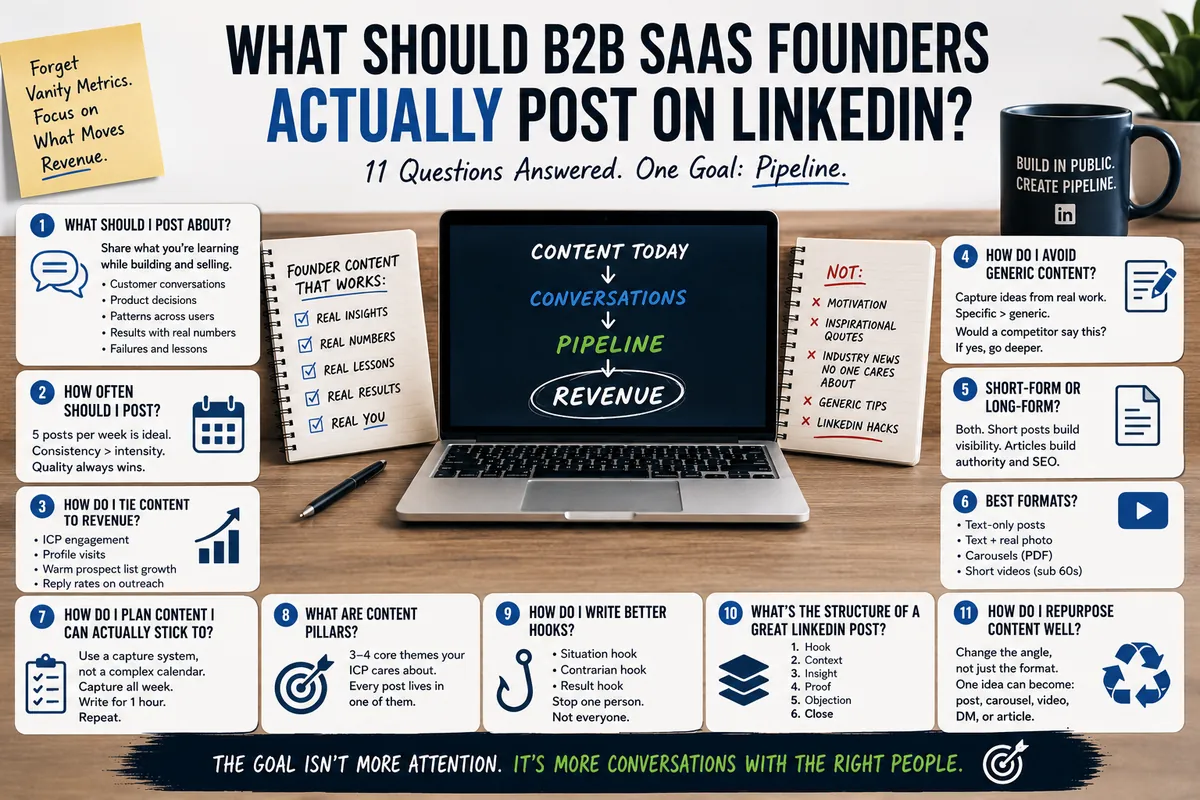
Most LinkedIn advice is designed for creators chasing followers.
Founders have a different goal.
Revenue.
Pipeline.
Conversations with buyers.
Nobody ever celebrated because a post got 500 likes from people who will never buy anything.
So let’s answer the questions B2B SaaS founders actually care about.
Simple.
Post about what you’re learning while building, selling, and growing your company.
Not recycled founder quotes.
Not “Monday motivation.”
Not screenshots of coffee and airport lounges.
The best content comes directly from the trenches.
Every customer call contains content.
What objection keeps appearing?
What question surprised you?
What misconception did you have to explain?
If buyers keep saying it, buyers want to read about it.
Why did you build Feature A but ignore Feature B?
What trade-offs did you make?
What did your team debate for weeks?
The decision-making process is often more interesting than the feature itself.
The third customer who says the same thing isn’t a coincidence.
It’s a trend.
And trends make great posts.
Instead of:
“Companies struggle with onboarding.”
Try:
“Three customers this month made the exact same onboarding mistake.”
Specific beats generic every time.
Everyone loves growth.
Almost nobody shares the process behind it.
Instead of:
“We improved retention.”
Try:
“We changed one onboarding screen and retention jumped from 31% to 58%.”
Numbers make people stop scrolling.
Especially failures.
LinkedIn is overflowing with people pretending everything works perfectly.
Reality is more interesting.
Talk about bad assumptions.
Bad hires.
Failed experiments.
Lost deals.
Nothing builds credibility faster than showing how you learned something the hard way.
The ideal system:
Five posts per week.
One every weekday.
But here’s the secret:
Consistency beats intensity.
Three quality posts every week will outperform seven rushed posts followed by two weeks of silence.
Think marathon.
Not New Year’s gym membership.
This is where most founders get lost.
They track:
Nice numbers.
Terrible business metrics.
Track these instead:
Are the people interacting with your posts actually potential buyers?
One comment from a decision-maker is worth more than 100 random likes.
Who’s checking your profile after reading?
If the right people are visiting, you’re attracting the right audience.
Create a list of everyone from your ICP who engages with your content.
That’s your warm outreach list.
Compare outreach to engaged followers versus cold outreach.
That difference is the true value of content.
Stop searching for ideas.
Start collecting them.
The best founders don’t sit down and think:
“What should I post today?”
They capture ideas throughout the week.
Customer insights.
Sales conversations.
Product debates.
Interesting numbers.
Tiny observations.
Then they write later.
The thinking happened already.
Both.
Each serves a different purpose.
Build awareness.
Create conversations.
Generate profile visits.
Drive DMs.
Build authority.
Rank on Google.
Get cited by AI tools.
Compound over time.
The best strategy:
4-5 short posts weekly.
1 longer article every week or two.
Think of articles as your content savings account.
Still incredibly effective.
Especially when they’re personal and specific.
A real founder beats stock photography every time.
Nobody trusts the smiling guy pointing at a hologram dashboard anymore.
Great for frameworks.
Processes.
Case studies.
Anything step-by-step.
Massively underused.
Keep it short.
Keep it simple.
One lesson.
One minute.
Done.
Don’t create a giant content calendar.
Create a capture system.
During the week:
Collect ideas.
Once a week:
Turn them into posts.
That’s it.
Simple systems survive.
Complicated systems become abandoned Notion pages.
Think of them as lanes.
Three or four core topics your audience cares about.
Example:
If you sell LinkedIn lead generation software:
Stay inside those lanes.
You don’t need endless variety.
You need repeated expertise.
Most hooks fail because they’re trying to attract everyone.
Great hooks target one specific buyer.
Examples:
“You’re posting every day on LinkedIn. The views are fine. The pipeline isn’t moving.”
“The founders generating the most revenue on LinkedIn usually have the smallest audiences.”
“We changed one onboarding step and doubled retention.”
Simple.
Specific.
Relevant.
The structure is surprisingly simple:
Get attention.
Explain the situation.
Deliver the lesson.
Show evidence.
Address skepticism.
Leave people thinking.
That’s the formula behind most high-performing founder content.
Not by copy-pasting.
That’s recycling.
Not repurposing.
Instead:
One article becomes:
Same insight.
Different delivery.
The best content should work harder than your sales team.
Most founders think LinkedIn success comes from posting more.
It doesn’t.
It comes from sharing things only you can say.
Your customer conversations.
Your product decisions.
Your wins.
Your failures.
Your lessons.
The goal isn’t to become a LinkedIn influencer.
The goal is to become the obvious choice when a buyer finally needs what you sell.
And surprisingly, that starts by talking less like a marketer and more like a founder.
We run your outbound and book qualified sales calls with decision-makers, so your team can focus on closing.
Get StartedIf you have a general inquiry and would like to speak to our expert team, you can contact us via email at: support@boxbytedigital.com