Creating great B2B content has never been the hard part.
Creating it every single week without draining your marketing team? That’s where things get interesting.
Most B2B SaaS companies know they should be publishing across blogs, LinkedIn, email newsletters, videos, and social media. The problem is that every new piece of content demands hours of research, writing, editing, approvals, and promotion.
Eventually, deadlines pile up, creativity takes a vacation, and consistency disappears faster than free pizza at the office.
The solution isn’t publishing more.
It’s getting more mileage from the content you’ve already created.
That’s exactly why I’ve started using Article Splintering.
Instead of treating a blog post as one finished asset, I treat it as the beginning of an entire content ecosystem.
One article can easily become weeks of high-quality content across multiple channels without reinventing the wheel every Monday morning.
Here’s the typical workflow:
Write article.
Publish article.
Share it on LinkedIn once.
Cross fingers.
Move on.
Unfortunately, that’s where most of the value disappears.
Content rarely reaches every potential buyer the first time around, especially in B2B, where purchasing decisions often take months and involve multiple stakeholders.
Publishing once isn’t a strategy.
It’s more like introducing yourself at a networking event and immediately walking out the door.
Many marketers respond by creating even more content.
More blogs.
More posts.
More emails.
More stress.
The problem?
Budgets stay the same.
Teams stay the same.
Deadlines get tighter.
Eventually quality suffers because everyone is trying to feed the content machine.
A smarter approach is making every piece of content work much harder.
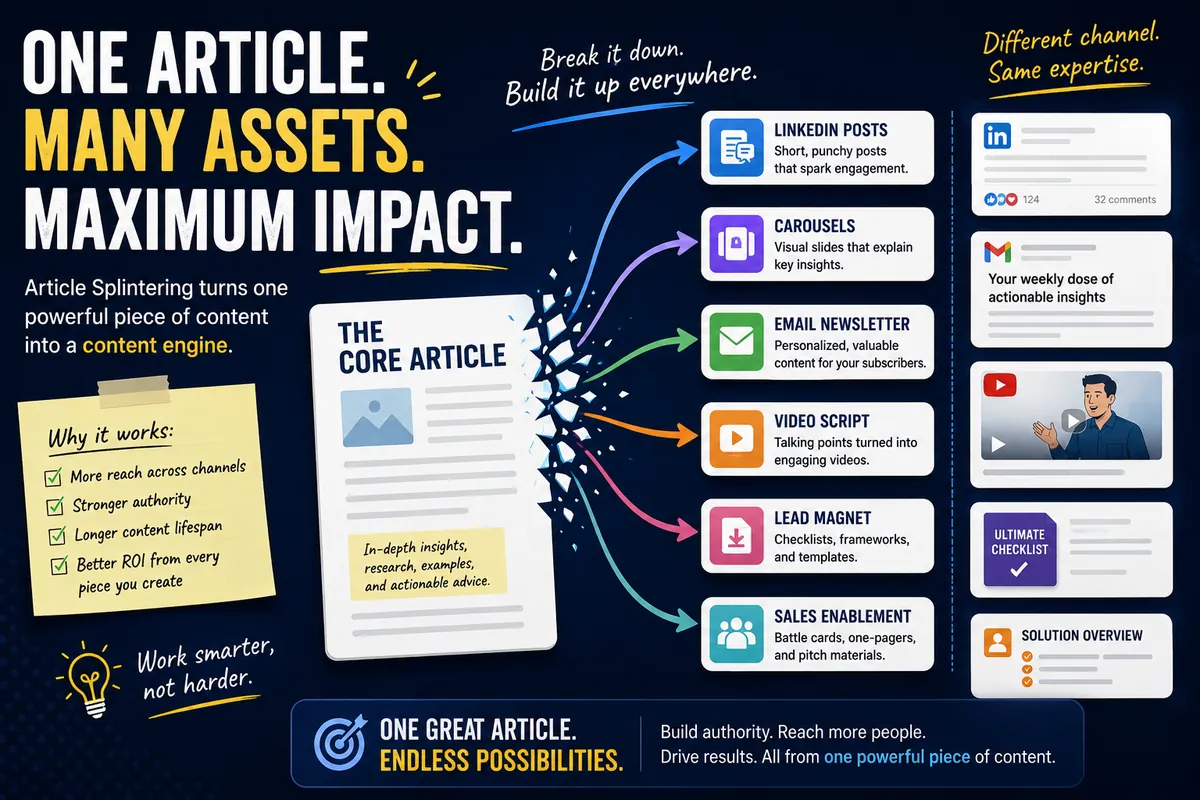
Article Splintering is a structured content repurposing strategy where one in-depth evergreen article is intentionally transformed into multiple standalone content assets.
Instead of copying and pasting the same material everywhere, every version is rewritten specifically for the platform it’s published on.
For B2B companies, this approach works because buyers don’t convert after reading one article.
They discover your brand through search, notice your LinkedIn posts, subscribe to your newsletter, attend a webinar, compare vendors, and only then decide to book a demo.
Article Splintering ensures your expertise appears throughout that entire journey.
Everything starts with a strong foundation.
Choose topics that answer meaningful customer questions, align with search intent, and remain valuable long after they’re published.
The goal isn’t simply to rank on Google.
It’s to create an authoritative resource capable of generating dozens of future content ideas.
Once the article is finished, break it into smaller standalone assets.
Look for things like:
Every one of these can become its own piece of content.
One comprehensive article can become:
Instead of creating ten new ideas, you’re expanding one great idea into multiple formats.
One mistake I see all the time is marketers copying the same content everywhere.
That rarely works.
Every platform has its own language.
A blog rewards depth.
LinkedIn rewards conversation.
Email rewards personalization.
Video rewards storytelling.
The insight stays consistent.
The presentation changes.
That’s what makes repurposing effective.
Instead of researching ten different topics, your team researches one topic thoroughly.
That investment produces weeks of content while dramatically reducing production time.
Consistency builds authority.
Article Splintering gives you a reliable publishing system without constantly staring at a blank document wondering what to write next.
Your audience sees valuable insights regularly, making your brand more memorable over time.
Evergreen content deserves a longer life than one LinkedIn post and a lonely blog page.
Repurposing keeps valuable ideas circulating for months, continually attracting readers and prospects.
SEO and social media shouldn’t compete.
They should support one another.
Search introduces new visitors.
Social keeps your expertise visible.
Together, they create far more impact than either channel alone.
Repurposing is not copy-pasting.
Audiences notice.
Algorithms notice.
Everyone notices.
Each platform expects content designed specifically for how people consume information there.
Good repurposing adapts:
The message remains the same.
Everything else evolves.
The biggest improvement came from planning the splinters before writing the article.
Now, before drafting anything, I already know:
Which sections will become LinkedIn posts.
Which ideas will become email newsletters.
Which framework becomes a carousel.
Which story becomes a video.
Planning first makes everything faster later.
Instead of asking, “What can I repurpose?”
I already know before I type the first sentence.
Not every article deserves a second life.
Skip repurposing content like:
If the original content isn’t valuable, multiplying it won’t magically improve the outcome.
Strengthen the source first.
Everything else becomes easier.
The real advantage comes from turning Article Splintering into a repeatable process.
Your workflow might include:
Track performance using metrics such as:
The data quickly reveals which formats deliver the biggest business impact.
Creating more content isn’t always the smartest strategy.
Creating more value from your existing content usually is.
Article Splintering transforms one evergreen article into an entire multi-channel marketing system that supports SEO, strengthens LinkedIn authority, and keeps your best ideas working long after publication.
Before assigning another blog topic to your marketing team, take a look at your existing content library.
There’s a good chance you’re already sitting on weeks—or even months—of untapped content.
Sometimes the best content strategy isn’t creating something new.
It’s finally giving your best ideas the audience they deserve.
We run your outbound and book qualified sales calls with decision-makers, so your team can focus on closing.
Get StartedIf you have a general inquiry and would like to speak to our expert team, you can contact us via email at: support@boxbytedigital.com