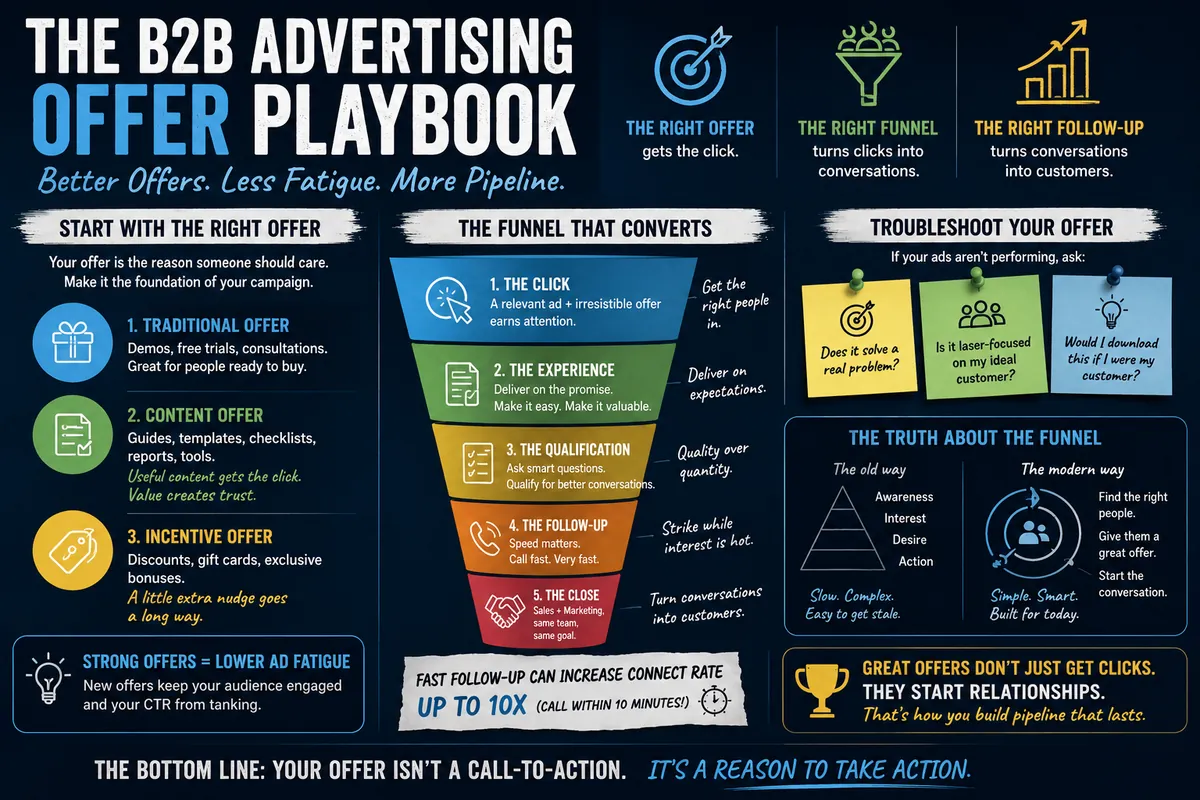
Ask ten marketers why their ads aren’t converting and you’ll hear the usual suspects:
“The targeting is off.”
“Our CPC is too high.”
“The algorithm hates us.”
Maybe.
But more often than not, the real culprit is much simpler:
Your offer isn’t interesting enough.
Most B2B campaigns spend weeks perfecting audience targeting, creative, and bidding strategies… only to end with a lonely “Book a Demo” button.
That’s like inviting someone to dinner and immediately asking them to marry you.
An offer isn’t just a call-to-action.
It’s the reason someone should care in the first place.
Instead of treating it like the final line of your campaign, make it the foundation everything else is built around.
Ask yourself:
“What would genuinely help my ideal customer today?”
That answer should shape your campaign—not the other way around.
Most successful campaigns fall into one of three categories.
These are the classics.
They’re effective—but only when buyers are already close to making a decision.
The problem?
Most aren’t.
This is where many of the highest-performing campaigns win.
Instead of asking prospects for a sales conversation, give them something useful.
Think:
People might ignore another demo invitation.
They rarely ignore something that saves them two hours of work.
A great content offer does three things at once:
• Generates leads
• Positions your company as the helpful expert
• Gives Sales an easier conversation starter later
The best content feels incredibly specific.
Your ideal customer should think:
“Were they spying on my Monday morning meetings?“
Sometimes people simply need a little nudge.
Discounts.
Gift cards.
Exclusive bonuses.
Limited-time perks.
The trick is relevance.
A Home Depot gift card for contractors beats another generic Amazon voucher every time.
Small personal touches create memorable campaigns.
Most marketers assume declining click-through rates mean it’s time for new creative.
Sometimes.
But often your audience is just tired of seeing the same message.
Nobody wants to read:
“Book a demo.”
For the 47th time.
Fresh content offers keep campaigns feeling new.
One month it’s a checklist.
Next month it’s an industry report.
Then a calculator.
Then a benchmark study.
Your audience keeps discovering something valuable instead of seeing the exact same sales pitch on repeat.
The result?
Lower fatigue.
Better engagement.
Longer-lasting campaigns.
Getting the click is just step one.
What happens afterward matters even more.
Your landing page should immediately answer one question:
“Was clicking this worth my time?”
If you’re collecting leads, don’t be afraid to ask qualifying questions.
Questions like:
Yes, longer forms may reduce conversion rates.
Good.
Because higher-quality leads beat larger spreadsheets every day of the week.
Timing matters more than most companies realize.
Someone downloads your guide.
Five minutes later…
They’re thinking about it.
Five hours later…
They’re thinking about lunch.
Five days later…
They don’t remember who you are.
The fastest teams consistently close more business because they’re reaching prospects while interest is still fresh.
Momentum disappears quickly.
Companies with self-serve products don’t rely on sales calls.
Instead, they rely on activation.
Every product has a moment where users experience value.
Maybe it’s:
If users don’t reach that milestone quickly, many never come back.
Speed creates habits.
Habits create customers.
Not exactly.
What’s dying is the old-school marketing playbook built around rigid awareness, consideration, and decision stages.
Today’s platforms are simply better at finding buyers.
Instead of manually building complicated audience ladders, modern algorithms already understand buying intent surprisingly well.
That doesn’t mean funnels disappear.
It means they’re becoming simpler.
Your customer’s buying journey still exists.
You just don’t have to micromanage every step anymore.
Every few months someone announces that:
“Gated content is dead.”
“Nobody shares email addresses.”
“MQLs are useless.”
Interesting theory.
Meanwhile, thousands of companies continue generating qualified pipeline using exactly those tactics.
Is gated content perfect?
Of course not.
But having imperfect data beats having no data at all.
Without measurement, every campaign becomes guesswork dressed up as confidence.
Too many companies treat marketing and sales like two separate departments playing different sports.
Marketing says:
“We delivered the leads.”
Sales says:
“They weren’t qualified.”
Everyone loses.
Great campaigns happen when marketing understands what Sales needs to close deals—and Sales shares feedback that improves future campaigns.
Revenue isn’t created by handoffs.
It’s created through collaboration.
If your paid campaigns aren’t performing, ask yourself:
If the answer isn’t an enthusiastic “yes,” neither will your audience.
Great targeting can’t rescue a weak offer.
But a compelling offer can make average campaigns perform exceptionally well.
At the end of the day, ads don’t succeed because they’re clever.
They succeed because they give the right people something genuinely worth clicking.
We run your outbound and book qualified sales calls with decision-makers, so your team can focus on closing.
Get StartedIf you have a general inquiry and would like to speak to our expert team, you can contact us via email at: support@boxbytedigital.com