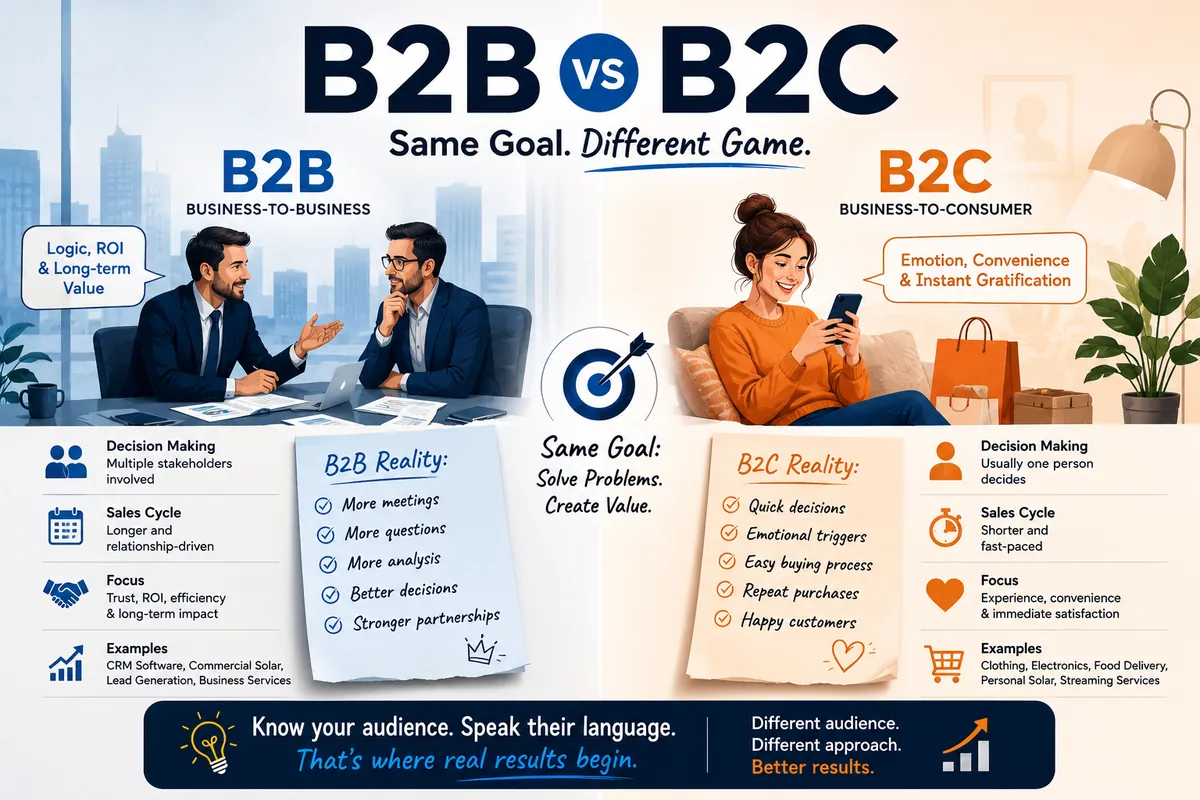
People often throw around the terms B2B and B2C like they’re interchangeable.
They’re not.
Sure, both involve selling products or services, but that’s where the similarities start to fade. The way you market, communicate, build trust, and close deals is completely different depending on who you’re selling to.
If you treat a B2B buyer like a consumer—or a consumer like a procurement manager—you’ll quickly discover why one strategy doesn’t fit all.
Let’s break it down.
Business-to-Business (B2B) means one company sells products or services to another company.
Instead of convincing one person to click “Buy Now,” you’re often convincing multiple stakeholders that your solution is worth the investment.
Think of products and services like:
Buying decisions usually involve finance teams, department heads, operations, and executives—all asking different questions before saying yes.
Business-to-Consumer (B2C) is exactly what it sounds like: businesses selling directly to individual customers.
Examples include:
Consumers typically make decisions much faster, and emotions often play a much bigger role than spreadsheets.
Although… we’ve all somehow convinced ourselves we needed that gadget we saw at 2 a.m.
B2B
One purchase can require approval from multiple people.
Finance wants ROI.
Operations wants efficiency.
Management wants results.
Everyone wants fewer meetings.
B2C
Usually one person decides.
If they like it, they buy it.
Sometimes after reading 87 reviews.
Sometimes after watching one TikTok.
B2B sales rarely happen overnight.
Conversations, demos, proposals, negotiations, legal reviews… and maybe another meeting just to schedule the next meeting.
B2C purchases often happen within minutes—or seconds.
Especially during a flash sale.
In B2B, relationships are everything.
Companies aren’t just buying a product.
They’re choosing a long-term business partner.
Trust, expertise, and consistent communication matter just as much as pricing.
In B2C, customer experience and convenience usually take center stage.
A smooth buying experience can turn a first-time buyer into a loyal customer.
B2B marketing answers questions like:
B2C marketing often focuses on:
Different audiences.
Different motivations.
Different messaging.
The biggest mistake businesses make isn’t selling the wrong product.
It’s communicating the right product the wrong way.
The best marketing doesn’t simply explain features.
It speaks directly to the audience’s priorities.
Businesses buy confidence.
Consumers often buy feelings.
Understanding which conversation you’re having changes everything.
Whether you’re generating leads, building content, running paid campaigns, or closing sales, success starts with understanding who you’re talking to.
For B2B businesses especially, sending thousands of generic messages rarely creates meaningful opportunities.
Personalized outreach.
Relevant conversations.
Clear value.
Those are the things that build trust—and pipelines.
Quality almost always beats quantity.
B2B and B2C may share the same goal—making sales—but the path to getting there couldn’t be more different.
One relies on long-term relationships, thoughtful decision-making, and business value.
The other often succeeds through emotion, convenience, and customer experience.
Knowing the difference isn’t just marketing knowledge.
It’s a competitive advantage.
Because when you understand how your audience buys, you can create messages they’re actually ready to hear.
We run your outbound and book qualified sales calls with decision-makers, so your team can focus on closing.
Get StartedIf you have a general inquiry and would like to speak to our expert team, you can contact us via email at: support@boxbytedigital.com