Someone recently noticed the “B2B” and “B2C” labels on my LinkedIn profile and asked what they actually meant.
Fair question.
For years, I looked at profiles full of mysterious acronyms and assumed everyone else had received a secret marketing dictionary that I somehow missed.
But the short answer is simple:
A B2B copywriter writes for businesses selling to other businesses.
A B2C copywriter writes for businesses selling directly to consumers.
Easy enough.
Except that’s not where the real difference lies.
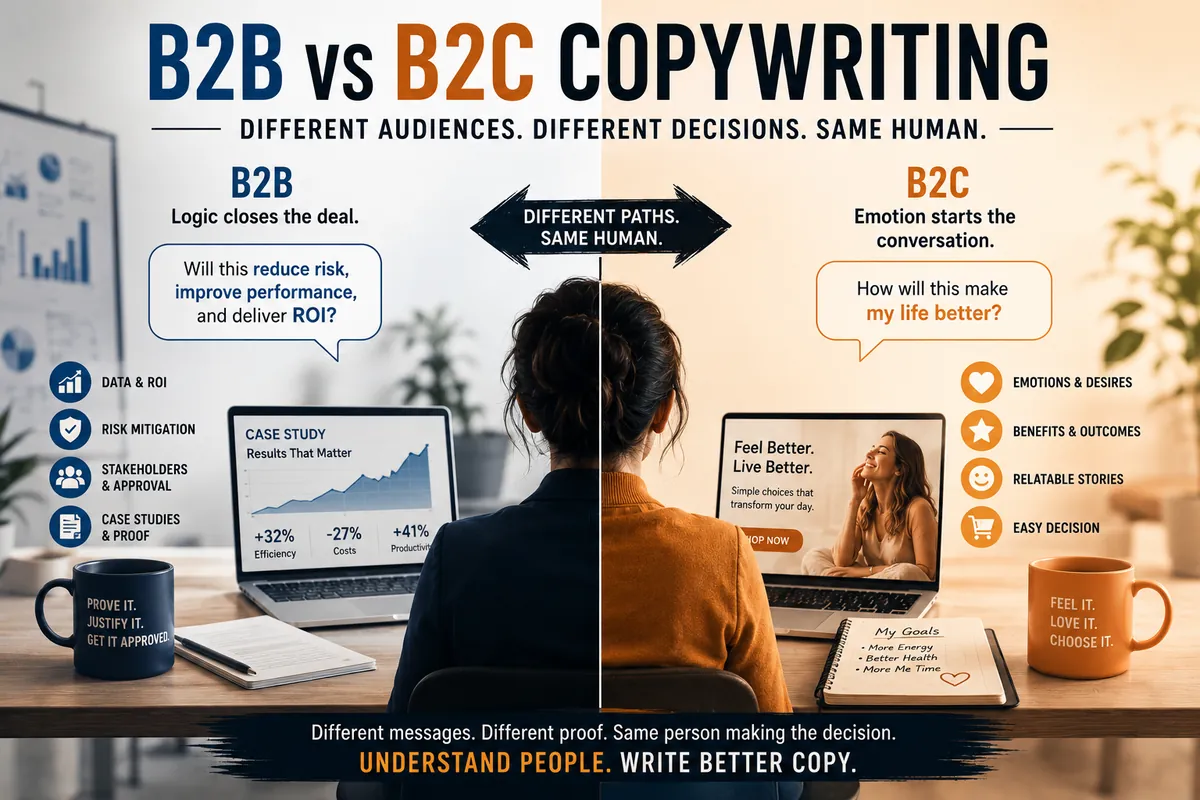
The longer I’ve worked in copywriting, the more I’ve realized that B2B and B2C aren’t separated by audience type alone. They’re separated by decision-making psychology.
And one lesson changed how I think about marketing entirely.
When I first started studying case studies as a marketing tool, I assumed they were primarily useful for things like:
After all, a great case study tells a far better story than a simple before-and-after photo ever could.
Then I entered the world of B2B marketing.
Suddenly, I discovered that some of the most powerful case studies weren’t selling fitness plans or skincare products.
They were helping organizations justify investments worth hundreds of thousands—or even millions—of dollars.
Medical equipment.
Software platforms.
Infrastructure systems.
Consulting services.
Technology implementations.
At that point, I realized something important:
B2B buyers aren’t just buying solutions.
They’re buying decisions they’ll eventually have to defend.
Most people assume the difference comes down to tone.
B2B is professional.
B2C is conversational.
B2B is logical.
B2C is emotional.
There’s some truth there.
But it’s not the full story.
Because businesses don’t make decisions.
People do.
Someone signs the contract.
Someone approves the budget.
Someone explains the purchase in a board meeting.
Someone answers uncomfortable questions if things go wrong.
Behind every company logo is a human being trying to make the right decision while avoiding the wrong one.
The real difference isn’t who buys.
It’s what happens if they make a bad choice.
Imagine buying a skincare product that doesn’t work.
Annoying? Sure.
You complain, throw it away, leave a mildly passive-aggressive review, and move on with life.
Now imagine approving a six-figure technology investment that fails.
Different story.
Maybe productivity drops.
Maybe implementation takes twice as long as expected.
Maybe your team hates using it.
Maybe the CFO starts asking questions you’d rather avoid.
Suddenly the stakes are much higher.
That’s why B2B buyers ask different questions.
They’re not just asking:
“Does this look good?”
They’re asking:
And often, they aren’t making the decision alone.
There may be:
The buying process becomes a group project nobody wanted but everyone has opinions about.
That’s why B2B copy relies heavily on:
In B2B marketing, proof isn’t decoration.
It’s the product.
Emotion may open the door.
Evidence closes the deal.
Consumer buying decisions tend to start from a more personal place.
People aren’t thinking about procurement committees.
They’re thinking about themselves.
Will this save time?
Will this make life easier?
Will this make me healthier?
Will this help me feel more confident?
Will this make me happy?
That’s why emotion often leads the process.
Relief.
Convenience.
Excitement.
Hope.
Confidence.
These emotions spark interest before logic gets involved.
Of course, consumers still want reassurance.
They read reviews.
Compare prices.
Research alternatives.
Check ratings.
But typically the heart starts the conversation.
The brain joins later to justify the purchase.
We’ve all done it.
“I absolutely need this.”
Five minutes later:
“Look, it’s basically an investment.”
Healthcare sits in a fascinating space because it serves both worlds.
Patients make deeply personal decisions.
They want clarity.
Safety.
Confidence.
Trust.
Sometimes the information literally affects their lives.
At the same time, healthcare organizations make business decisions.
They evaluate:
Their priorities often revolve around:
Different audiences.
Different motivations.
Same underlying need.
They both want answers that help them make the right decision.
That’s why healthcare marketing taught me a valuable lesson:
The best marketers don’t obsess over channels.
They obsess over understanding people.
After writing for both B2B and B2C audiences, one thing has become increasingly clear.
Great copywriting isn’t about clever wording.
It’s about understanding how people make decisions.
Sometimes people want hope.
Sometimes they want certainty.
Sometimes they want inspiration.
Sometimes they just want reassurance that they’re not about to make an expensive mistake.
The language changes.
The evidence changes.
The buying journey changes.
But underneath it all, you’re still talking to a person.
Someone trying to solve a problem.
Someone comparing options.
Someone hoping they’re making the right choice.
Whether they’re booking a healthcare appointment, buying a fitness program, investing in enterprise software, or approving a major capital purchase…
They’re still human.
And maybe that’s the biggest lesson of all.
B2B and B2C aren’t opposites.
They’re different paths leading to the same destination:
Helping people feel confident enough to say “yes.”
We run your outbound and book qualified sales calls with decision-makers, so your team can focus on closing.
Get StartedIf you have a general inquiry and would like to speak to our expert team, you can contact us via email at: support@boxbytedigital.com