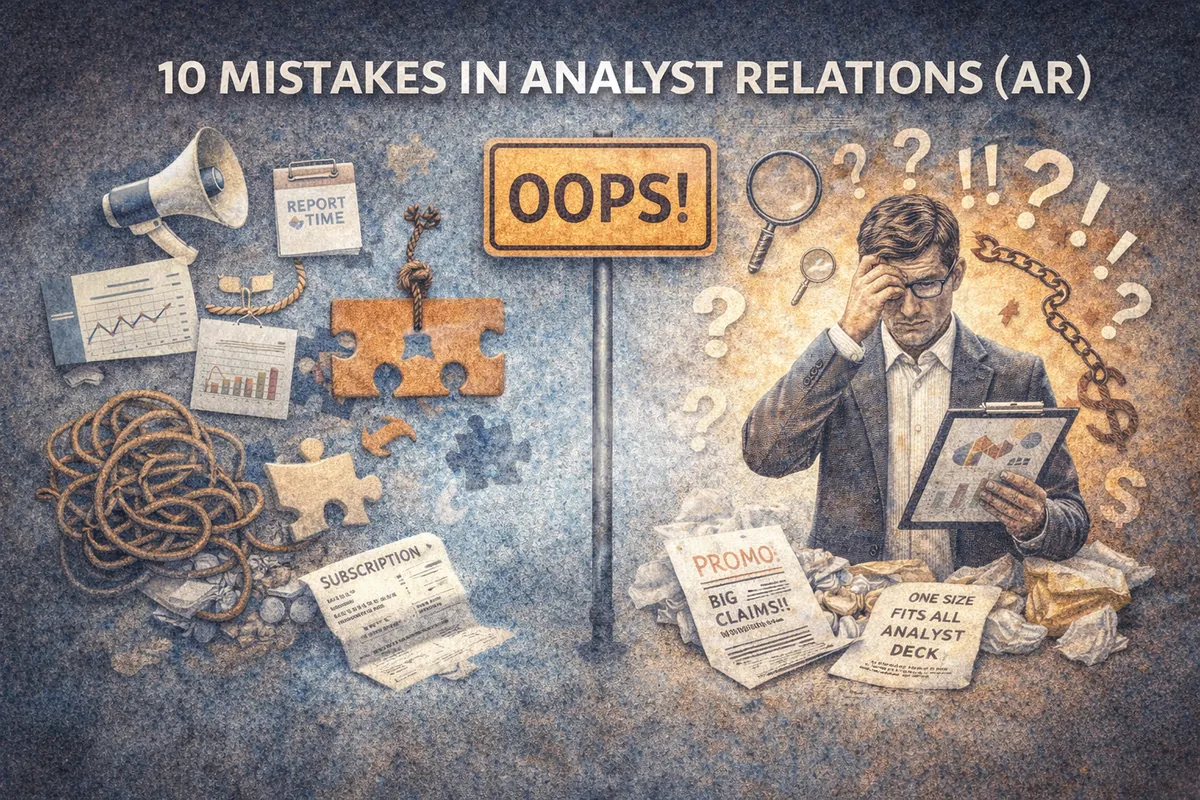
In modern B2B buying, analyst relations (AR) shape far more than reports and rankings. Analysts influence how categories are defined, which vendors make the shortlist, and how risk gets justified inside buying committees. In enterprise and upper mid-market deals, analyst perception often decides whether you’re considered at all.
And yet, AR is still one of the most misunderstood functions in B2B.
Across SaaS, platforms, and B2B services, we see strong companies with real traction struggle to earn analyst credibility. Not because they aren’t working hard — but because they’re making the same structural mistakes over and over.
Here are the ten most common AR mistakes we see in practice, why they backfire, and what actually works instead.
Many teams approach analysts the same way they approach press: polished launches, bold claims, and aspirational positioning.
Why it fails Analysts aren’t there to amplify messaging. Their job is to evaluate reality. Promotional language makes them skeptical and cautious.
What works Ground conversations in buyer pain, real adoption patterns, and honest boundaries — including what your product doesn’t do yet.
Some companies appear once a year, right before a Magic Quadrant or Wave.
Why it fails Analysts form opinions continuously. If you disappear, their understanding freezes in time.
What works Consistent, low-pressure updates that help analysts track progress incrementally.
Nothing damages credibility faster than mixed messages from product, sales, and marketing.
Why it fails When ICPs, value props, or differentiation don’t line up, analysts default to conservative positioning.
What works Pre-brief alignment on narrative, proof points, and outcomes.
Many briefings try to prove depth by listing everything the product can do.
Why it fails Analysts care less about feature volume and more about why buyers choose you.
What works Outcome-led stories anchored in real customer use cases.
Some teams talk the entire time and never ask for feedback.
Why it fails Analysts often see market shifts before vendors do.
What works Turn briefings into working sessions. Ask what buyers are changing, questioning, or deprioritizing.
AR is often tracked as activity, not influence.
Why it fails Without business linkage, AR gets deprioritized during budget reviews.
What works Connect AR to deal acceleration, shortlist inclusion, and narrative lift.
Analyst subscriptions are sometimes treated as shortcuts to credibility.
Why it fails Paid access amplifies existing narratives — it doesn’t fix unclear positioning.
What works Establish narrative clarity and evidence first, then invest.
One deck, many analysts, minimal traction.
Why it fails Analysts differ in coverage, personas, and priorities.
What works Tailor narratives to the analyst’s focus and buyer audience.
Some teams reset the story every briefing.
Why it fails Analysts build understanding cumulatively.
What works Plan narrative arcs across quarters so progress feels coherent.
AR and partnerships often live in separate worlds.
Why it fails Analysts increasingly assess ecosystem strength as part of vendor credibility.
What works Integrate partner proof and implementation outcomes into analyst conversations.
AR isn’t a checkbox, a report tactic, or a subscription line item. It’s a strategic discipline built through clarity, consistency, and evidence.
Teams that avoid these mistakes don’t just improve analyst perception. They reduce deal friction, sharpen GTM execution, and build narrative authority that compounds over time.
Done right, AR becomes one of the most underestimated drivers of durable B2B growth.
We run your outbound and book qualified sales calls with decision-makers, so your team can focus on closing.
Get StartedIf you have a general inquiry and would like to speak to our expert team, you can contact us via email at: support@boxbytedigital.com